Tag
Gleason grading
9 entries all tags
Sep 6, 2026 Sep 5, 2026 Sep 3, 2026 Sep 2, 2026 Aug 30, 2026 Jan 13, 2022 
Apr 9, 2020 
Feb 25, 2020 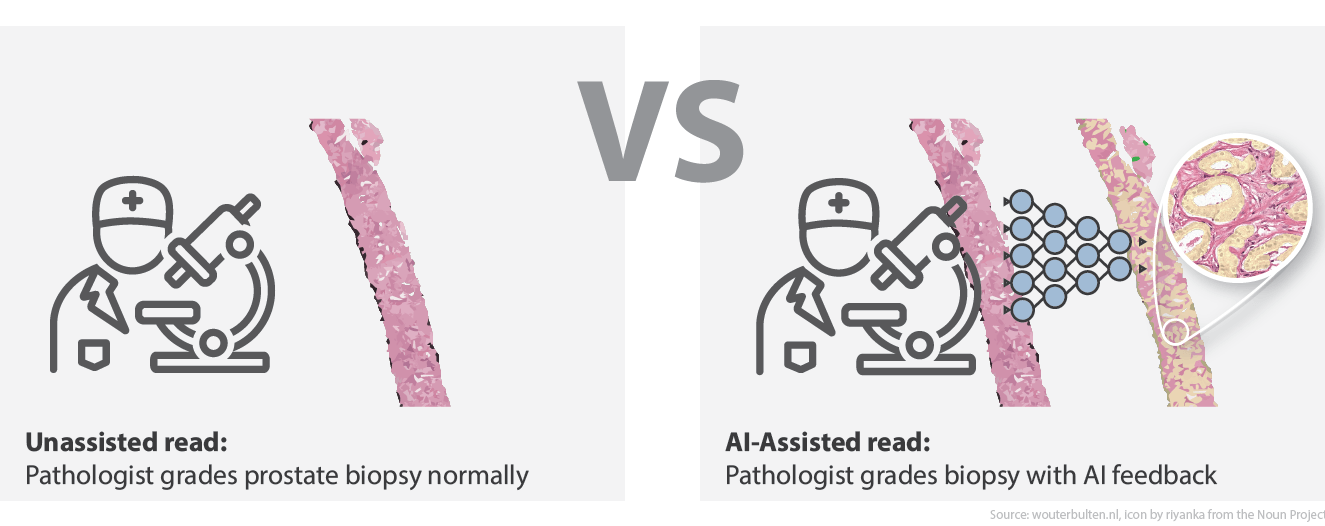
Jul 23, 2019 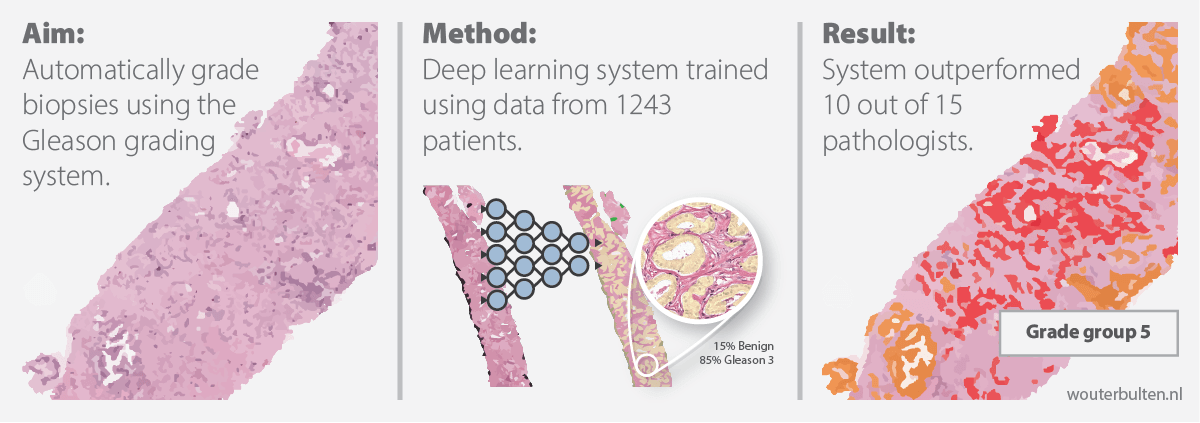
General discussion 2022 thesis · Ch. 6 A look back at the four studies and forward: how AI support fits a pathologist's workflow, and what diagnostics could look like beyond Gleason grading.
AI-assisted Gleason grading 2022 thesis · Ch. 5 Fourteen pathologists graded 160 biopsies with and without AI assistance. With the AI they agreed more with the expert reference, and beat the standalone system.
The PANDA Challenge 2022 thesis · Ch. 4 A global competition on 10,616 public biopsies drew 1,290 developers. The resulting algorithms matched pathologist-level grading on blinded US and EU cohorts.
Automated Gleason grading of prostate biopsies 2022 thesis · Ch. 3 We built a deep-learning system that grades prostate biopsies without manual annotations. It matched the expert consensus and outperformed 10 of 15 pathologists.
General introduction 2022 thesis · Ch. 1 How prostate cancer is diagnosed and graded, why Gleason grading varies so much between pathologists, and what deep learning brings to the problem.
AI for diagnosis of prostate cancer: the PANDA challenge Artificial intelligence (AI) for prostate cancer analysis is ready for clinical implementation, shows a global programming competition, the PANDA challenge.
Improve prostate cancer diagnosis: participate in the PANDA Gleason grading challenge Can you build a deep learning model that can accurately grade prostate biopsies? Participate in the PANDA challenge
The potential of AI in medicine: AI-assistance improves prostate cancer grading In a completely new study we investigated the possible benefits of an AI system for pathologists. Instead of focussing on pathologist-versus-AI, we instead look at potential pathologist-AI synergy.
Pathologist-level Gleason grading using artificial intelligence (AI) & deep learning We developed a fully automated deep learning system to grade prostate biopsies using 5759 biopsies from 1243 patients, and showed that this system achieved pathologist-level performance.